
The Shrinking Standard
By Kelly Behr
After nearly a decade of body positivity at the forefront of fashion marketing, retailers have, yet again, started to pivot strategies in response to changing beauty standards. While the stereotypical thin ideal has always steadily thrummed, the pressure to formally act on shrinking ourselves had momentarily lifted even if it persisted atmospherically. And yet, despite the fashion industry’s forward thinking, the scales seem to be tipping backwards as the rise of GLP-1s takes root.

A recent report from Forbes and Impact Analytics traced how the uptick in prescribed weight loss has affected retail’s ability to adequately address supply and demand, from unexpected inventory levels to size distortion. These reports remain largely backward-facing, interested primarily in revenue and business practices. What’s not so clear is how exactly consumers are shaping the industry and what this means on a societal level, not just a commercial one.
Dr. Serena Volpi, a fashion anthropologist and professor at Lorenzo de’ Medici in Florence, Italy, explained the origins of body modification and its long-term effects on the industry. “My perspective is deeply rooted in my mother’s work as a seamstress…[and] she often spoke of the post-WWII era as a time of necessity and intimacy with garments…If a garment didn’t fit, you didn’t discard it—you fixed it. Clothing was expected to adapt to the body,” Volpi said.
It wasn't until the 1940s and 1950s that standardization became an industry-wide practice. In 1939, the United States Department of Agriculture (USDA) began what are known as anthropometric studies, essentially an attempt at generalizing the proportions of the human body. These findings positioned the body against an industrial standard and defined the landscape of the 20th century.
“As Elsa Schiaparelli famously noted… 'It's not clothes that ought to adapt to the body. It's the body that ought to adapt to clothes," Volpi continued. Eventually, the standards set forth by the USDA, and those mimicked abroad, were abandoned by the 1980s. Superficially, this would've been an opportune time to turn inclusive, but instead “the 'body adapting to clothes' became even more arbitrary, leaving consumers chasing a moving target,” Volpi said. It leaves society wondering who’s responsible for the implications of these standards? Is this exclusionary design permissible because shoppers continue to purchase despite it? How do retailers cushion their shoppers' egos? Ultimately, neither party wants to take responsibility, and the tug-of-war relationship results in disillusionment and complacent behavior.
As the industry has evolved, retailers have responded by toying with numerical validation, or “vanity sizing,” by labeling garments with a smaller, more elusive size than their actual measurement. “It’s a psychological sleight of hand. Instead of adapting the clothes to the body, or forcing the body to adapt, vanity sizing adapts the label to the ego,” Volpi explained.
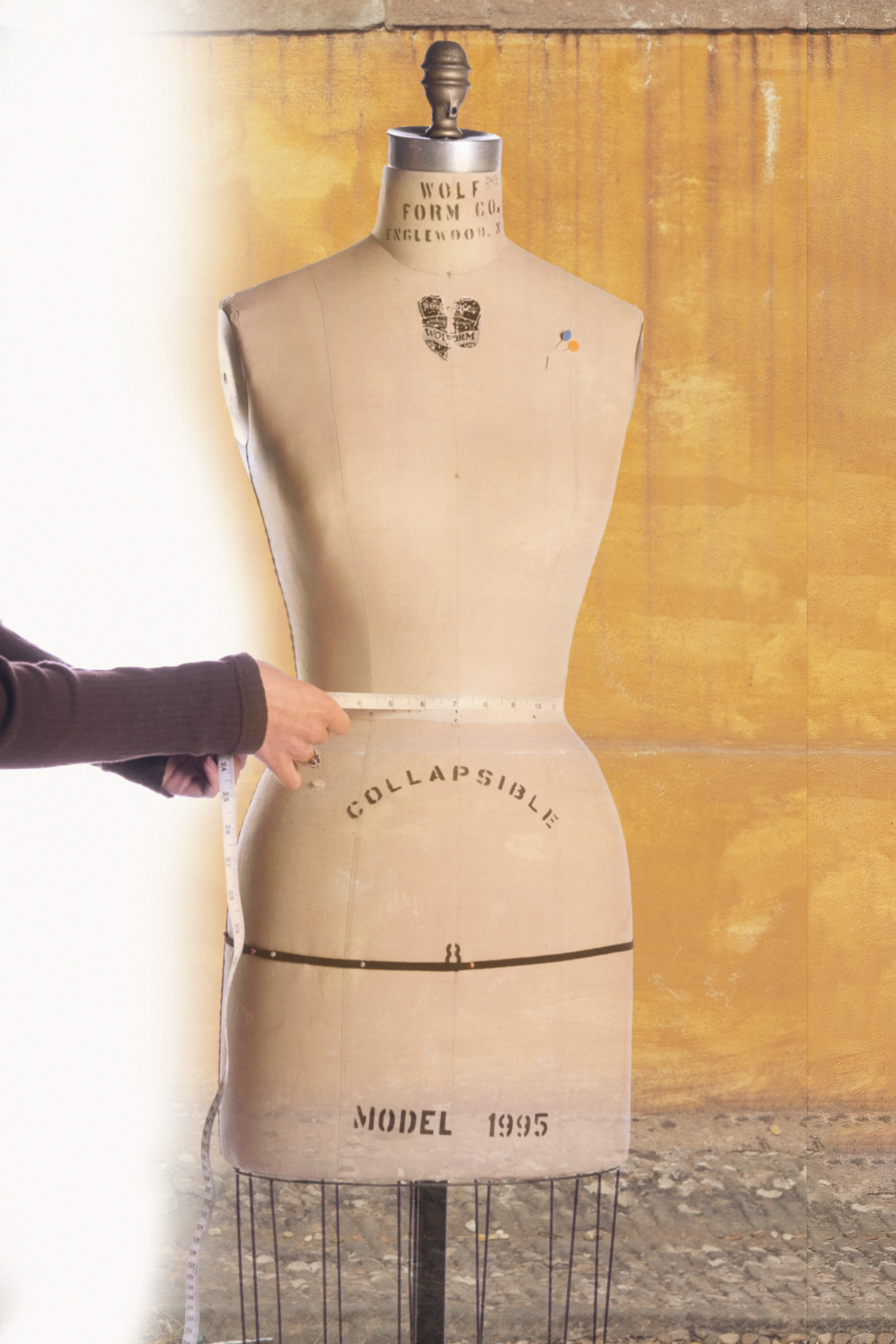
But the novelty’s worn off in the face of mass media’s persistent idealization of women’s shrinkage. “When diet and exercise failed, surgical intervention became the next step. Today, GLP-1 drugs represent a further evolution: chemical intervention,” Volpi went on. So, while the ideal remains strong, the mechanisms deployed to meet its benchmarks are shifting.
“Fashion is part of how we stabilize our identity…[but] today, stability is sought in the body itself,” Volpi said. As GLP-1 popularity grows, it further strains the intimate connection to the body. “If the technology to 'adapt the body' exists, failing to do so may be seen as a moral failing. We risk moving from a culture where clothes are a form of expression, to one where they are a certificate of successful bodily management,” Volpi added.
Various advertisements pose these drugs as accessible, life-changing tools to achieve self-acceptance. Their presence, however, “creates a new hierarchy based on access…the barrier to entry shifts from willpower to wealth,” Volpi explained. The opportunity to get hands on these drugs is now contingent on a slew of other factors deeply rooted in systemic failures around the world. If fashion is tightly bound to our identities, then how might the potential risk of denied use affect those whose bodies have always been chained to the periphery?
From micro-managed marketing to medically managed bodies, “industry” is the iron claw. That power continues despite the changing retail landscape. “If the industry perceives the plus-size market as shrinking, they may reduce investment, viewing it as a 'failing' sector…It threatens to turn plus-size fashion from a marginalized sector into an endangered one,” Volpi concluded. So, vanity sizing will not be enough when year-over-year revenue holds more weight across several industries.
“Perhaps the disruption of the GLP-1 era is an opportunity to invert this again,” Volpi said. “Imagine if, instead of a 'Size 42' or 'M', the label read: 'Fits Waist 74-78 cm, Hips 98-102 cm'?" she continued.
In an AI-led, partisan-disrupted world, a return to accurate measurement might be, dare I say… refreshing? It would offer a sense of clarity, a moment of truth. Imagine walking into every store knowing exactly what size you need to grab? Imagine a sizing chart that didn’t make you convert arbitrary letters or numbers to measurements you didn’t understand?
Although this might feel overly optimistic, or altogether impossible, taking a purely cynical approach is similarly unproductive. At one point it would’ve been inconceivable to standardize sizing, and now it's commonplace; circular design went from an aspiration to a consumer's expectation.
Volatility, more often than not, results in waves of redefining the norm. In the attempts to regain order, the changes we yearn for fill the cracks that need mending. So, it's essential to believe in possibility and potential now more than ever. This GLP-1 ridden ecosystem brings a whole lot more than just sizing distortion to the surface, and we must unpack its baggage.
